DEXA and seca measure the same thing using completely different physics. One passes low dose X-ray through you and separates tissue by what it absorbs. The other passes an imperceptible electrical current through you and separates tissue by how it conducts. That single difference drives everything else, including which one you actually need.
The Short Answer
DEXA is the only one of the two that also measures bone mineral density. seca is the only one of the two you can repeat every month without thinking twice about it, because there is no radiation and no separate appointment.
Neither is a better scan in the abstract. They answer different questions. If you want the groundwork first, our overview of what body composition analysis measures covers the fundamentals this article builds on.
What a DEXA Scan Does
DEXA stands for dual energy X-ray absorptiometry. You lie still on a table for roughly six to ten minutes while a scanning arm passes over you.
DEXA reports three things: fat mass, lean soft tissue, and bone mineral content. Bone is the one no impedance device can give you, and it is the reason DEXA exists in the first place. The body composition report is a secondary use of a machine designed to diagnose osteoporosis.
The radiation dose is genuinely small. A body composition DEXA is usually quoted between 1 and 10 microsieverts. A chest X-ray is around 100. It is one of the lowest dose imaging tests in medicine, and nobody should avoid a medically indicated DEXA out of radiation fear.
There is one thing worth understanding about the DEXA muscle number, because it is widely misread. DEXA does not measure skeletal muscle. It measures lean soft tissue, which is everything that is not fat and not bone: muscle, yes, but also organs, connective tissue, and the water held in all of it. Researchers describe appendicular lean mass as a proxy for muscle rather than a direct measurement of it. For most people most of the time the proxy tracks muscle closely enough. It is still a proxy.
What a seca Scan Does
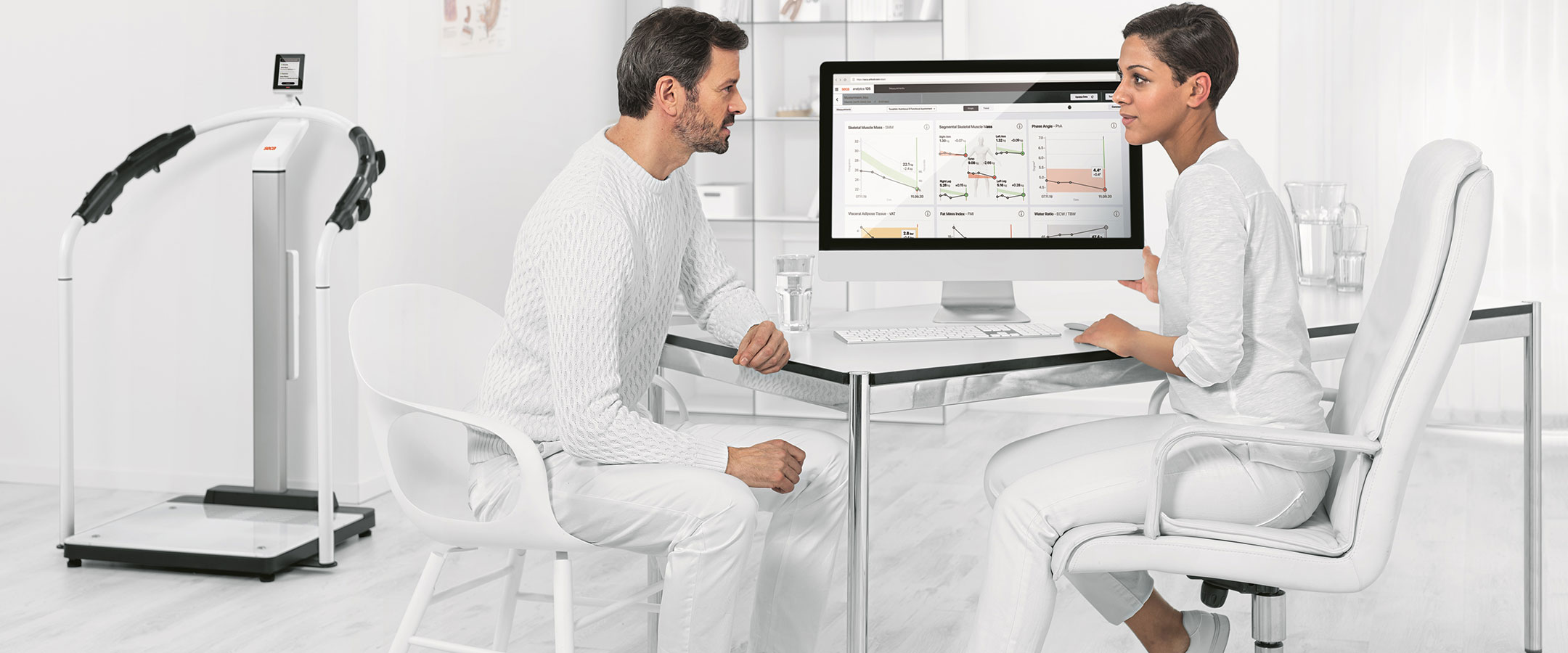
The seca mBCA is a medical body composition analyzer. You stand on it, hold two handgrips, and it is finished in about twenty seconds.
It uses phase sensitive, multi frequency bioelectrical impedance analysis across eight electrodes. Low and high frequency currents behave differently depending on whether they pass through fluid inside cells or outside them, which is how the device separates tissue types rather than just estimating a single body fat figure.
A seca scan reports fat mass, fat free mass, skeletal muscle mass, total body water split into intracellular and extracellular, visceral fat, phase angle as a marker of cell integrity, and the same breakdown segment by segment for each arm, each leg, and the trunk.
The device was validated against whole body MRI rather than against DEXA. In a 2017 study in the European Journal of Clinical Nutrition, the seca equations explained 97 percent of the variance in total skeletal muscle mass measured by MRI, 91 to 94 percent for limb muscle, and 80 to 81 percent for visceral fat. MRI is the harder reference to beat, because unlike DEXA it can actually isolate muscle tissue.
What it cannot do is tell you anything about your bones. If bone density is the question, no impedance device answers it.
Where InBody Fits
InBody is bioelectrical impedance too. Same underlying physics as seca, same general family of outputs, and in a gym or a wellness center it is the device you are most likely to meet.
The practical differences are in device class and in the reference standard each manufacturer validated against. Most impedance devices are validated against DEXA. seca validated against MRI. Since DEXA reports lean soft tissue rather than isolated muscle, a device calibrated to match DEXA inherits that limitation in its muscle number.
This is a real distinction, not a reason to distrust an InBody result. If you have been tracking on an InBody and the numbers are consistent, that history has value. The thing that will ruin your data is switching devices mid program and comparing across them. Absolute values differ between manufacturers. Pick one device and stay on it.
Side by Side
| DEXA | seca mBCA | InBody | |
|---|---|---|---|
| Technology | Dual energy X-ray | Phase sensitive multi frequency BIA | Multi frequency BIA |
| Radiation | Yes, very low (about 1 to 10 microsieverts) | None | None |
| Scan time | 6 to 10 minutes, lying down | About 20 seconds, standing | Under a minute, standing |
| Bone density | Yes | No | No |
| Muscle reading | Lean soft tissue, a proxy | Skeletal muscle, validated against MRI | Varies by model |
| Usual reference standard | Is itself a reference | MRI | Usually DEXA |
| Practical to repeat monthly | Not really | Yes | Yes |
| Where you get it | Imaging center or specialty clinic | Medical offices | Gyms, wellness centers, clinics |
| Offered at Florida Aesthetics and Wellness | No | Yes | No |
Which One Do You Actually Need
Get a DEXA if bone is part of the question. Osteoporosis risk, a long history of significant weight loss, a fracture, a medication that affects bone, or a program or study that specifically names DXA as the required method. Nothing else substitutes.
Get a seca scan if you want to know what is happening to your body month to month. Anyone on a medical weight loss program, anyone on a GLP-1 medication who wants to confirm they are losing fat rather than muscle, anyone whose scale has stalled, anyone whose BMI has been flagged and does not believe it.
The honest reason to favor repeat impedance scans over a single DEXA during active weight loss is not accuracy. It is frequency. One perfect measurement in March tells you almost nothing in June. Six good measurements tell you the direction you are moving, and direction is the thing a weight loss program is actually steering by.
What Neither of Them Does Perfectly
No body composition method in routine clinical use is exact. The true criterion methods are MRI and multi compartment models, and they live in research settings.
Impedance readings move with your fluid status. Hydration, a large meal, a hard workout, alcohol, and the point in a menstrual cycle all shift the result, sometimes by more than the real change you are looking for. The fix is procedural: scan at the same time of day, under the same conditions, ideally before eating and before exercising. Compare scans taken the same way, not scans taken whenever.
Impedance is not for everyone. Bioelectrical impedance is generally avoided in people with implanted electronic devices such as pacemakers, and readings are less reliable in pregnancy and in conditions causing significant fluid retention.
DEXA has a hydration problem too. It is often left out of the comparison, but shifts in body water also distort the lean soft tissue reading on a DEXA, and DEXA tells you nothing about muscle quality.
Do We Offer DEXA at Florida Aesthetics and Wellness?
No. We offer the seca medical body composition analysis, not DEXA.
If what you need is a bone density scan, you need an imaging center, and your primary care physician can order one. We would rather tell you that plainly than have you book the wrong scan.
If what you need is to understand your fat, muscle, water, and visceral fat, and to watch those numbers change while you are doing something about them, the seca scan is the right tool and you can have the result in the same visit. Results are reviewed with you by your provider during the same appointment.
This post is for educational purposes only and does not constitute medical advice, diagnosis, or treatment. Individual results vary. Consult a qualified medical provider before starting any weight loss program.
Frequently Asked Questions
What is the difference between a DEXA scan and a seca scan?
DEXA uses two low dose X-ray beams and reports fat mass, lean soft tissue, and bone mineral density. A seca scan uses phase sensitive bioelectrical impedance, involves no radiation, takes about twenty seconds, and reports skeletal muscle mass, fat mass, visceral fat, and body water. DEXA is the only one that measures bone. seca is the one that is practical to repeat monthly.
Is DEXA more accurate than seca or InBody?
It depends on what is being measured. DEXA is a long established reference for fat mass. For muscle it reports lean soft tissue, which includes organs, water, and connective tissue, so it is a proxy rather than a direct measurement. The seca mBCA was validated against whole body MRI and explained 97 percent of the variance in total skeletal muscle mass. Neither replaces MRI, which is the true criterion method.
Is the radiation from a DEXA scan dangerous?
No. A body composition DEXA is typically 1 to 10 microsieverts, compared with roughly 100 for a chest X-ray. It is one of the lowest dose imaging tests available. The reason we use impedance instead is not safety, it is that a twenty second scan with no separate appointment can be repeated as often as your program needs.
Can I compare an InBody result to a seca result?
Not reliably. Absolute values differ between manufacturers, so a change between two different devices may be a device difference rather than a real change in your body. Choose one device and track on it consistently.
How should I prepare for a body composition scan?
Scan under consistent conditions so your results are comparable. Ideally come at a similar time of day, before eating, before exercising, and normally hydrated. Impedance readings shift with fluid status, so consistency matters more than any single preparation step.
Do you offer DEXA scans in Brandon?
No. Florida Aesthetics and Wellness offers seca medical body composition analysis. If you need a bone density scan, that requires an imaging center and your primary care physician can order one.